Writing
Process
This reflective space serves as a live methodology for my academic writing. I approach ENC1102 as a laboratory for analytical evolution, where each draft is a record of evolving critical consciousness and scholarly inquiry.
Ongoing Reflection Log
September 18th, 2026
Portfolio Outcome 1: Initial reflections and Artifacts
To me, genuine inquiry is an established question that is developed following learning about a general topic that contains a reasonable and answerable primary question. This question should be followed by and backed up with provable data or research surrounding relevant topics. My artifacts show my inquiry developing from the central question of “How do individuals tend to change their text structure/grammatical formatting depending on the platform and individual they are communicating to over the internet?” forming a question surrounding ‘anonymity in online forums’ with a focus on ‘how they act differently towards peers and strangers’ in my conversation with Professor Watkins. This led me to develop the central question of "How does the perceived anonymity of online platforms influence the rhetorical choices and tone of user discourse when interacting with strangers compared to known peers?". My thinking was deepened from thinking about grammar and how people tend to structure their text to how people may change how they talk based on if they would have to interact with the person with a focus on perceived anonymity. This inquiry has prepared me slightly more for the project by helping me deepen my understanding of how I understand the definition of genuine inquiry, helping me develop a central question, and helping me identify possible sources for help should I hit a roadblock.
Article 1: Discussion Post.
This article helped me start to generate a line of general inquiry that would lead to becoming my genuine inquiry. In my "general inquiry" section, I was starting to ideate more on the specifics of what my genuine inquiry would be, which was general questions that could later be defined more specifically. My work producing this article was challenging simply because I was somewhat unfamiliar with a writing process like this one. I had not tried ideating a topic idea under something so broad, and as such I became slightly stuck in a sense as I was unsure of what a question I have could have been. This was also partially solved in this article as writing it out and reading responses helped me start to grasp what I needed a bit more. Overall, this helped my question evolve from no real general question, to "In online interaction, how is an emotion conveyed and received from both parties differently than a face-to-face interaction?" to something more along the lines of "in online interaction, how do both parties interact with each other across different platforms if they know each other".
Article 2: Topic Adjustment Notes.
The second article helped me go from a more broad and less defined general inquiry to a more specific and focused genuine inquiry as I was helped to reshape some facets of my topic to better represent my core question. While developing this work, the largest challenge I faced during the process was articulating my topic of interest. I am somewhat unfamiliar with the process of speaking aloud about what I want to do, and as such I have a hard time finding alternative wording or help in clearly stating what I need help with specifically. This article was particularly impactful to my prompt as it is proof of how my conversation with Professor Watkins reshaped my question to better say what I was trying to ask. The conversation helped me change my question that I left off with of "In online interaction, how do both parties interact with each other across different platforms if they know each other" to the final version of "How does the perceived anonymity of online platforms influence the rhetorical choices and tone of user discourse when interacting with strangers compared to known peers?"


October 8th, 2026
Portfolio Outcome 2: Information Literacy
Article 1: Annotated Secondary Source
When selecting the first article, the primary thing I learned on how to find sources effectively is displayed through my selection of the article itself. I end up using the annotations on the article to help support my main point itself instead of using it to attempt to answer my primary research question. My usage of quotes to support parts of my primary research question and build background knowledge helped me broaden my sources that I could select to help me write on my primary research question. A challenge I faced when annotating was choosing what information was actually pertinent enough for me to use for my writing. I had to analyze all my quotes I had selected as possible candidates and whittle down to a small handful that I believed would be extremely valuable for my question. Previous insights that relate to my first article would be how I was having trouble articulating my topic of interest. When I was taking quotes, I had trouble finding parts of the essay that would be of great use to my overall point, however, I solved this problem by breaking down the primary research question I had developed and answering parts of it at a time.
Article 2: Primary Research Collection Results
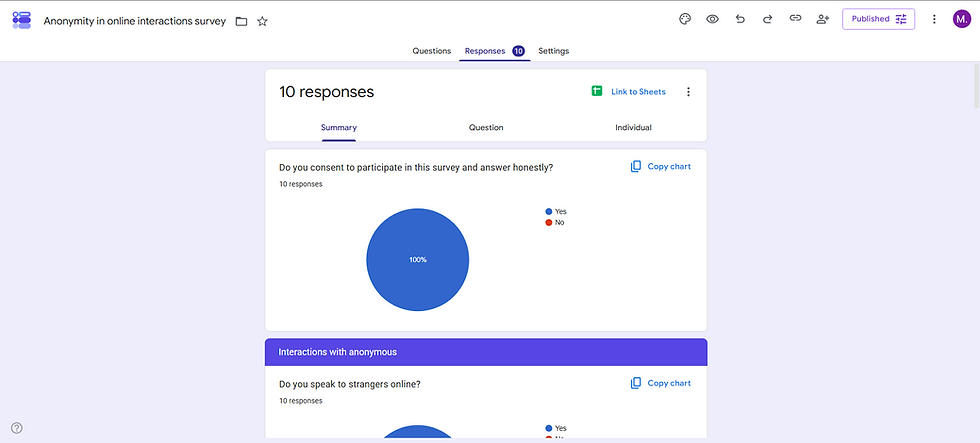
Currently, I am having some trouble with getting people to respond, however, I am resolving this and reaching out more to have more responses. An ethical consideration I had to make when collecting the data from my google form survey was the guarantee of anonymity. I did not want to collect people's personal data that would not provide anything to the survey, so, I decided not to collect emails or ask questions that would help me be able to identify people even a little bit. This assurance of anonymity is very helpful as it helps prevent bias from me as a researcher, as well as allowing respondents to answer completely honestly without worry of someone judging their choices. This article means a lot to me as it is representative of my hard work. I needed to go out and find the first 10 responses that I got, which while not a lot, did take some effort. I had to step very far out of my comfort zone and talk to people I was not familiar with, which I tend to avoid. As such, while I don't have a lot of responses currently, I hope to have more in the future through giving people the electronic survey and interacting with individuals to coerce them to fill it out. I would say that this article is also particularly important to answering the outcome of information literacy as I need to be completely aware of the questions themselves. When making the questions, I had to think about what data I wanted to collect, how my respondents may misinterpret the questions or ways to respond, and more. I also needed to completely understand what my collected data meant, which leads me to having to demonstrate my information literacy.